

Buy now
Book2Look for Core Themes
Core Themes
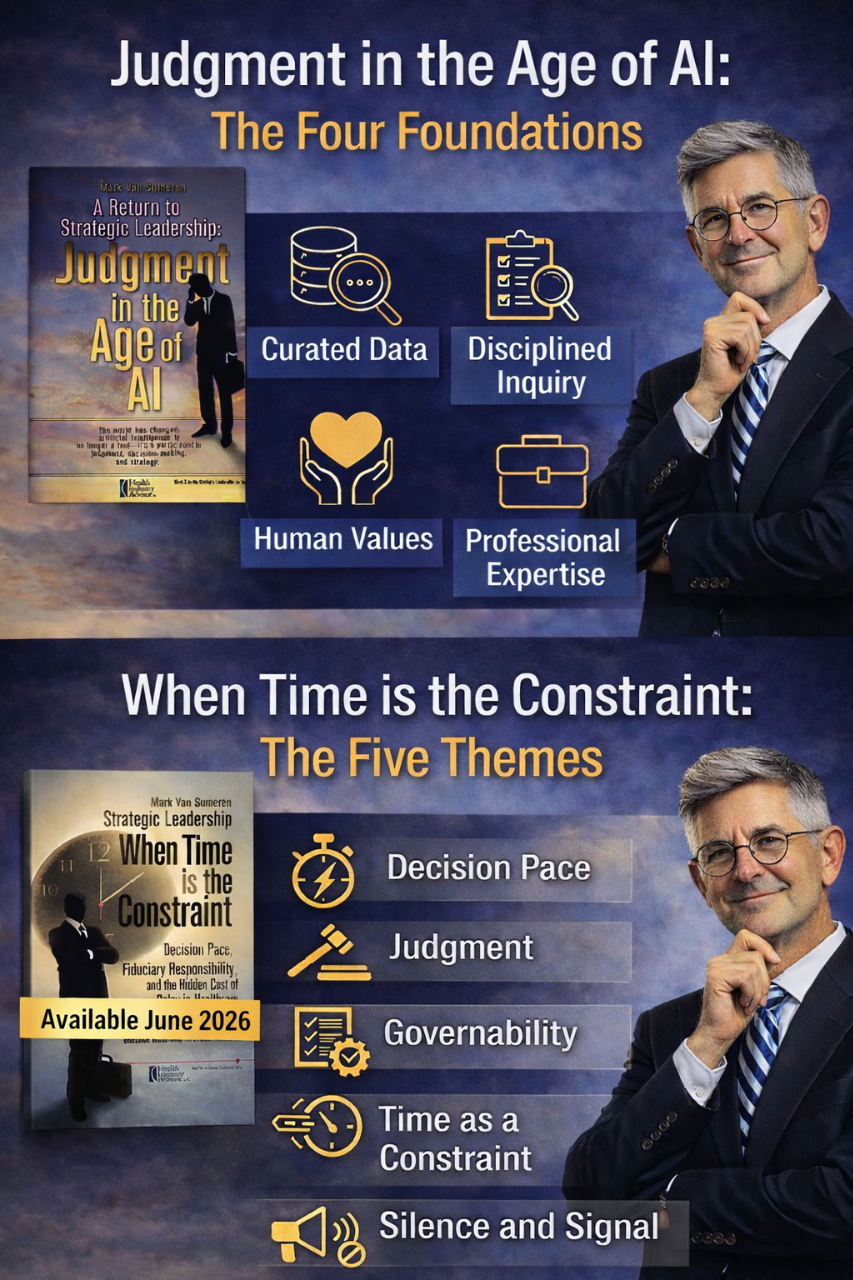
Book 3: Strategic Leadership: When Time is the Constraint
Decision Pace
Decisions that drift continue to consume resources, attention, and optionality. Decision pace is not a managerial preference; it is a capacity constraint.
Judgment
In an era of abundant intelligence, judgment becomes the scarce resource. Leadership is defined not by analysis, but by the willingness to decide under uncertainty.
Governability
Institutions do not fail because leaders lack integrity. They underperform because governance structures make delay rational and accountability abstract.
Time as a Constraint
Time is not neutral. It reallocates cost, risk, and leverage whether or not decisions are made explicitly.
Silence and Signal
Systems that reward compliance without protecting dissent will hear the truth only after action is no longer possible.
Book 2: A Return to Strategic Leadership: Judgment in the Age of AI
While artificial intelligence dramatically expands access to information and accelerates analysis, it does not eliminate the need for judgment—it magnifies it. As intelligence becomes ubiquitous and speed becomes commoditized, the true differentiator shifts from answers to discernment. The book frames this discernment around four foundational disciplines that together define sound judgment in the age of AI.
Curated Data
Curated data emphasizes that judgment begins not with more information, but with better information—data that is intentionally selected, contextualized, and grounded in lived experience. Without curation, data volume creates noise rather than insight.
Disciplined Inquiry
Disciplined inquiry focuses on the quality and precision of the questions being asked, recognizing that AI can only be as insightful as the curiosity that guides it. Strong judgment requires questions that surface assumptions, challenge frames, and explore second- and third-order consequences.
Human Values
Human values provide the ethical and moral context that governs how intelligence is applied. Without explicit values, even accurate analysis can lead to outcomes that are misaligned, harmful, or corrosive to trust.
Professional Judgment
Professional judgment is the experienced interpretation that turns analysis into action, integrating data, questions, and values into decisions that account for consequence and responsibility. It is the one element that cannot be automated and remains the ultimate differentiator in leadership.